Method: Follicular Unit Excision
Approach: Doctor-led Procedure
Surgeons: GMC, ISHRS Registered
Cost: £3,000 – £7,000
Grafts: Based on patient’s hair loss
FUE Hair Transplant




GMC-Registered Surgeons
Every procedure at Hair Transplant Leeds is performed by a doctor on the GMC register
Leeds City Centre Clinic
Centrally based and easy to reach from across Yorkshire and the surrounding region
Free Consultation, No Sales Pressure
An honest look at your hair loss and what surgery can realistically achieve for you
One Surgeon, One Patient Per Day
Your surgeon focuses solely on your procedure, undivided attention from the first incision to the last graft
At Hair Transplant Leeds, FUE (Follicular Unit Extraction) is the method we perform most frequently. It is minimally invasive, leaves no linear scar at the donor site, and produces natural-looking results when performed by an experienced surgeon. This page covers exactly how the procedure works, who is suitable, what recovery looks like, and what it costs in Leeds.
FUE Hair Transplant in Leeds
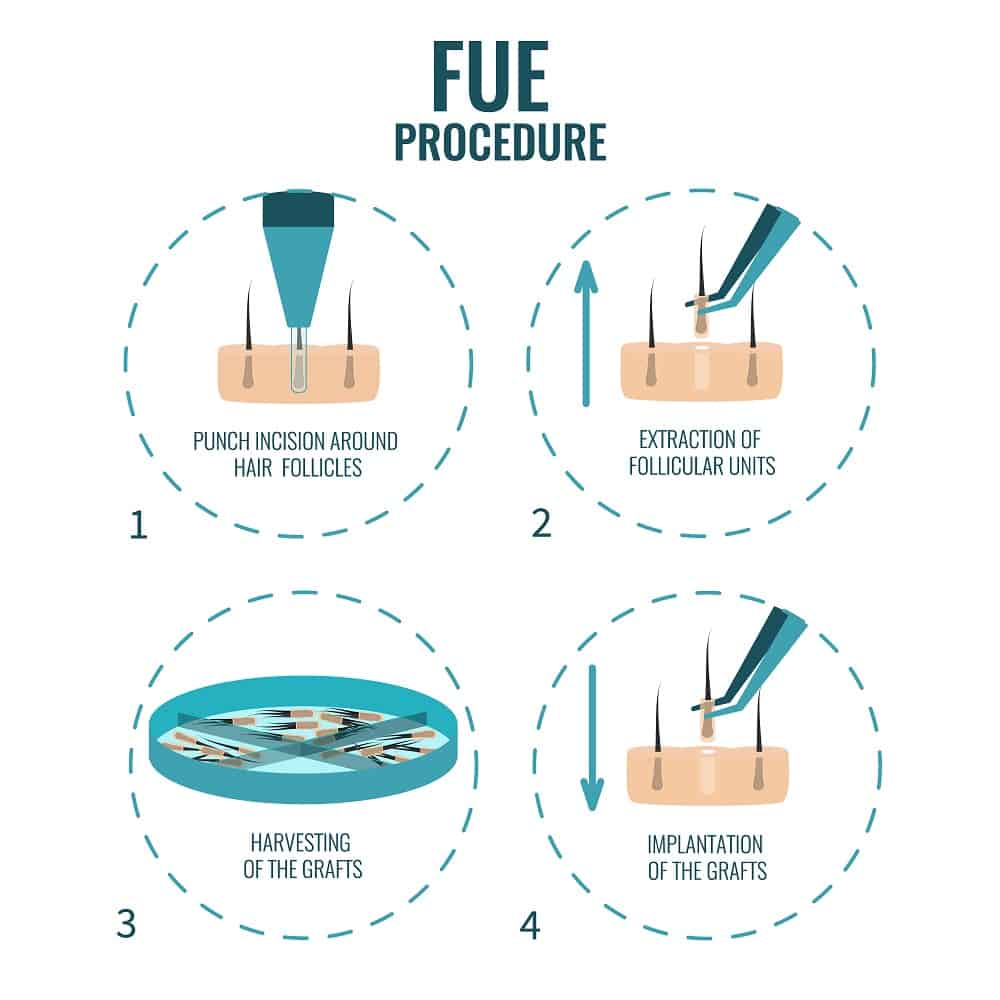
FUE extracts individual hair follicles from the back and sides of the scalp (the donor area) using a small 0.75mm to 0.85mm punch device, then implants them into the recipient area. Because each follicle is extracted one by one rather than via a strip incision, there is no linear scar. Patients can keep their hair short without any visible scarring at the donor site.
The follicles used in FUE come from the DHT-resistant zone at the back and sides of the head. Because they are genetically resistant to the hormone responsible for male pattern hair loss, they continue to grow after transplantation and are considered a permanent solution.
FUE is suitable for treating receding hairlines, crown thinning, beard restoration, and eyebrow restoration. It is also used for scar revision in patients who have had previous strip (FUT) surgery.
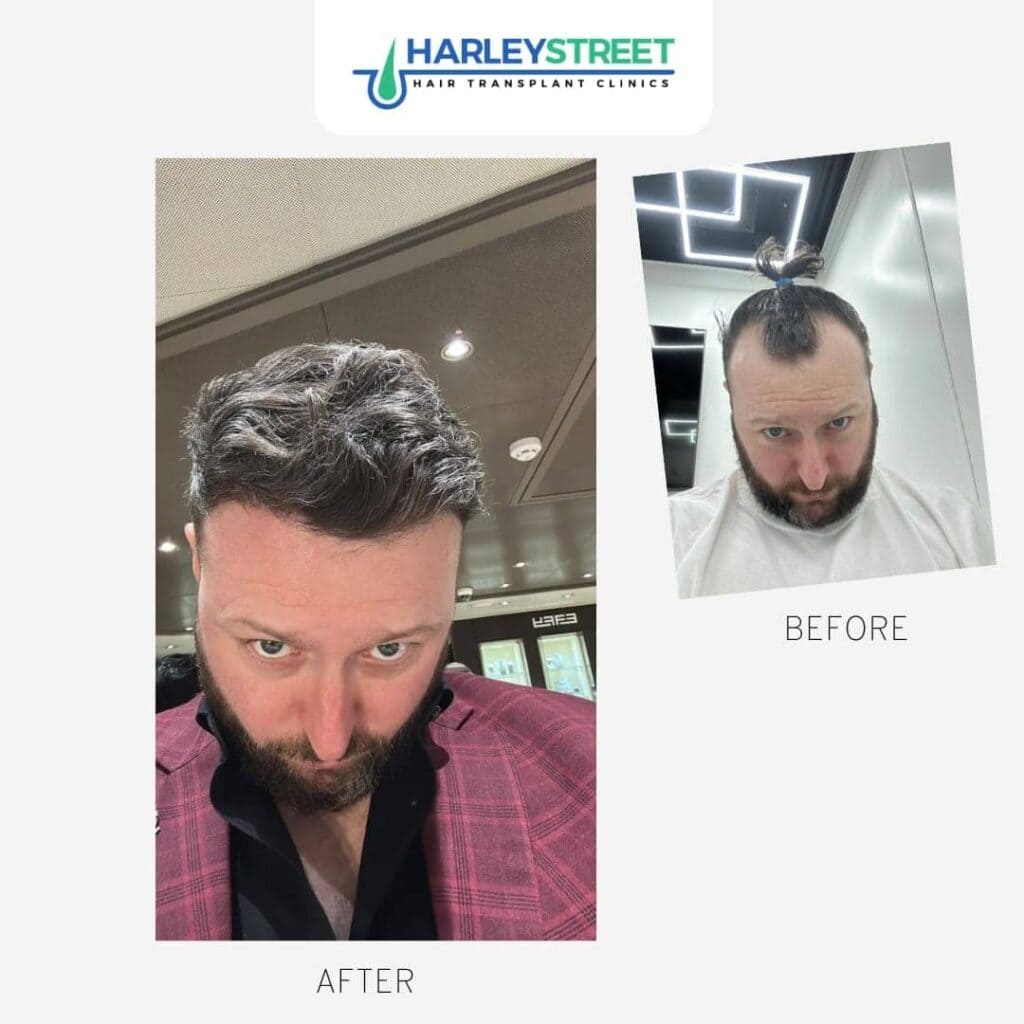
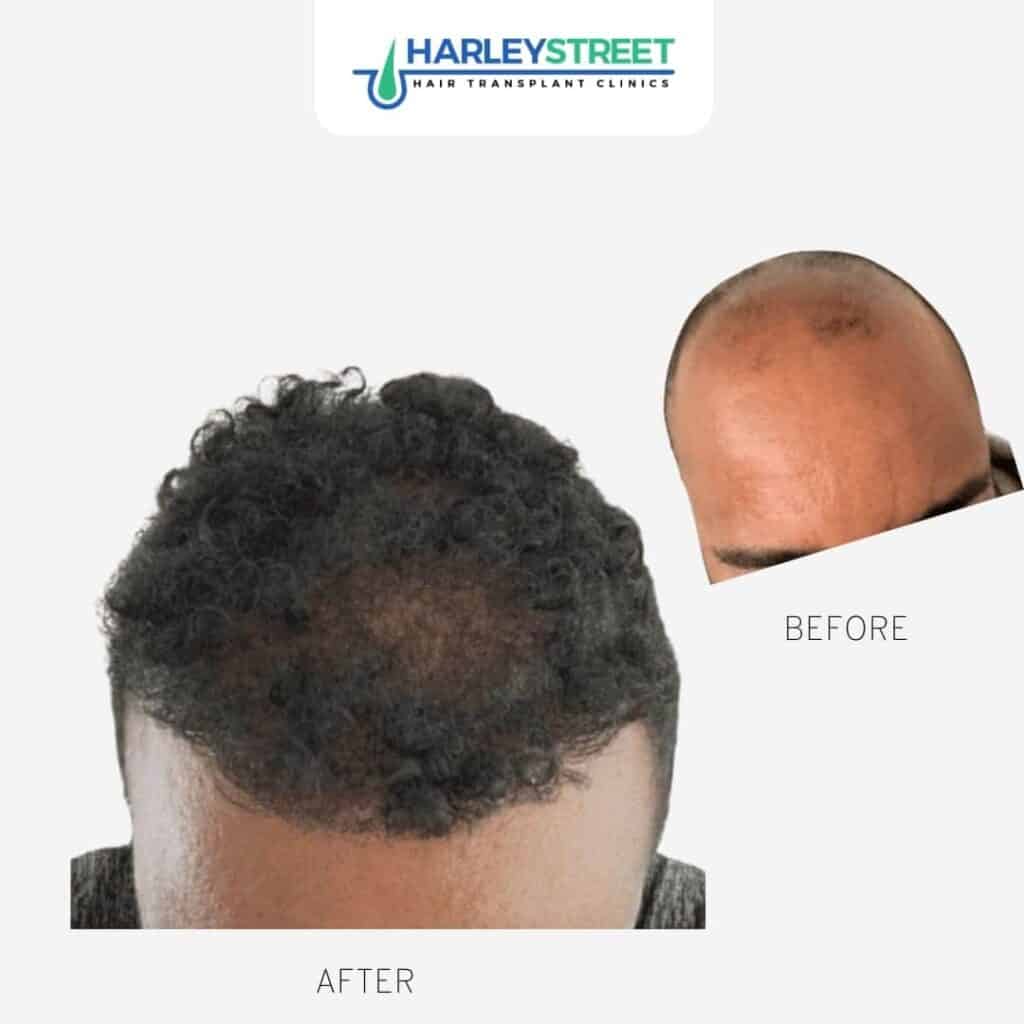
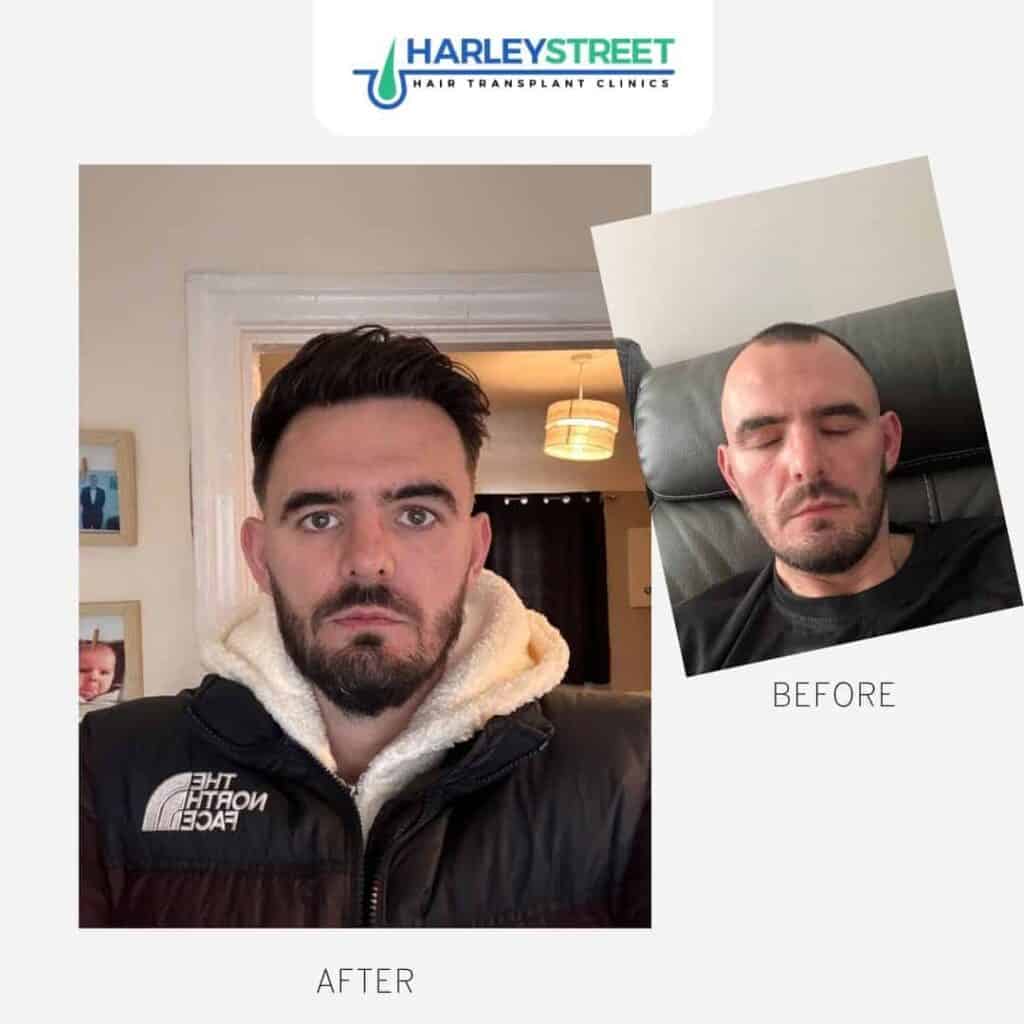
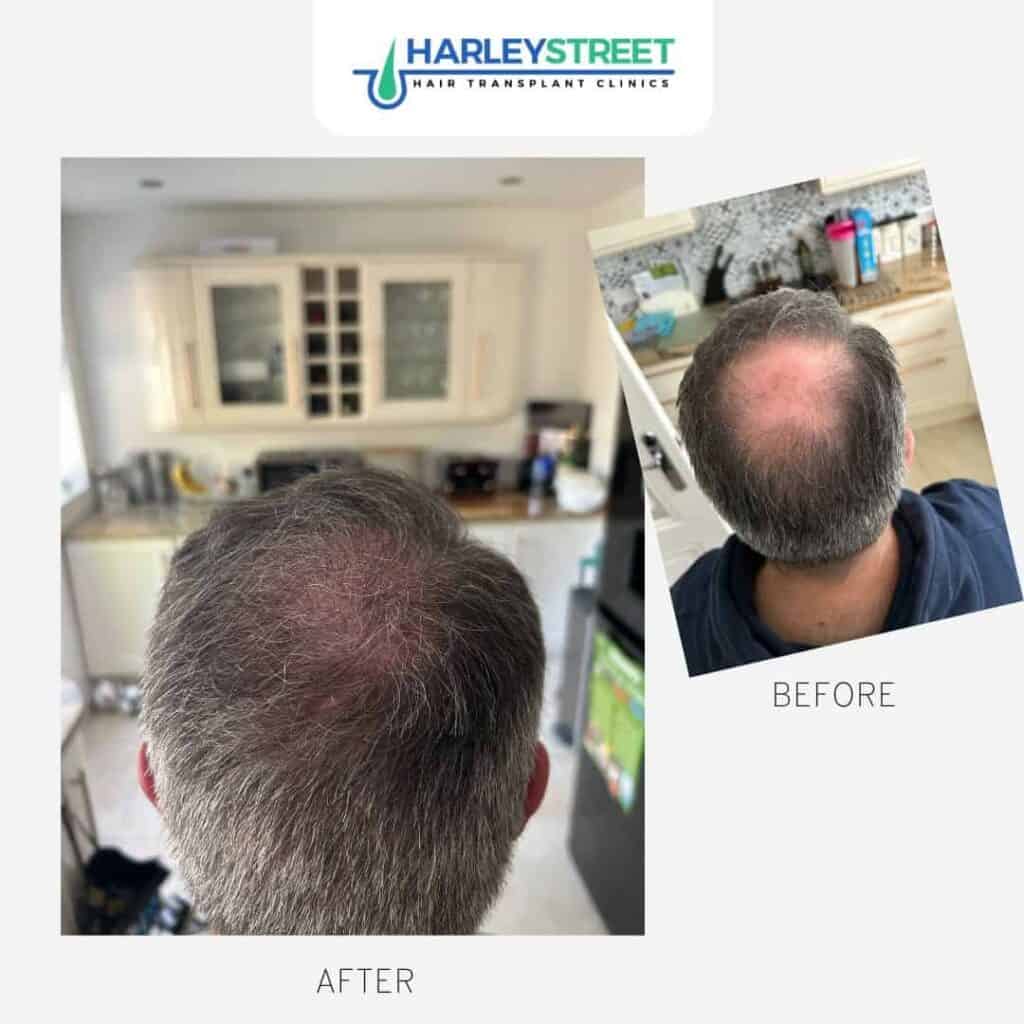
Before and After FUE Hair Transplant Results in Leeds
A selection of results from patients treated at our Leeds clinic. All procedures were performed by our GMC-registered surgeons.
How the FUE Procedure Works
Consultation and Planning
Before any extraction takes place, you meet your surgeon for a pre-surgery consultation. The hairline or recipient area is designed and agreed. No incisions are made until you are satisfied with the plan.
Extraction Phase
The donor area is shaved and local anaesthetic administered. The surgeon uses the punch device to extract grafts individually. At Hair Transplant Leeds, the surgeon performs the extraction themselves. The technician team remove the extracted grafts with medical forceps and store them in saline solution to protect them while outside the body.
Grafts are sorted into singles, doubles, and triples as they are extracted. Singles are used at the very front of a hairline to create a natural, soft transition. Doubles and triples provide density further back into the mid-scalp and crown.
Incision Phase
Once extraction is complete, the surgeon plans and makes the incisions in the recipient area. The angle, depth, and direction of each incision determines the final look. This is the phase that most determines whether a result looks natural or artificial, and it is performed exclusively by the surgeon.
Implantation Phase
The technician team implant the prepared grafts into the incision sites. Grafts are placed to match the natural growth direction of the recipient zone. The full procedure typically takes 5 to 9 hours depending on the surface area treated and graft count required.
Aftercare
After surgery you receive a full aftercare kit and access to our aftercare portal, which covers saline spraying, sleeping position, washing protocol, and what to expect day by day in the first two weeks. Follow-up appointments are scheduled at two weeks, three months, six months, and twelve months.
FUE vs DHI: Which is Right for You?
Both FUE and DHI (Direct Hair Implantation) extract follicles individually from the donor area. The difference is in how they are implanted. In standard FUE, the surgeon creates the incision sites first, then the team implants the grafts into those sites. In DHI, a Choi implanter pen makes the incision and places the follicle simultaneously.
DHI gives the surgeon greater control over the angle and direction of each graft, making it particularly suited to hairline work where precise geometry matters most. Standard FUE is more efficient for larger surface areas such as the crown, where the priority is graft count rather than micro-precision at the front edge.
At your consultation, your surgeon will advise which method, or combination of both, gives the best result for your specific pattern of hair loss.
FUE vs FUT
FUT (Follicular Unit Transplantation) is the older strip method. A strip of skin is removed from the donor area, dissected into individual grafts, and implanted. FUT leaves a linear scar at the donor site but allows a large number of grafts to be harvested in a single session, making it useful for patients with extensive hair loss or limited donor density who prefer not to have multiple FUE sessions.
FUE is the preferred method for the majority of patients. No linear scar, shorter recovery, and suitable for most stages of hair loss. The right choice depends on donor density, extent of hair loss, and whether the patient intends to wear their hair short.
A Selection of Our Before and After Results
Make the best investment in yourself and find out more about how we can help eliminate hair loss for good!
Who is Suitable for FUE in Leeds?
FUE is suitable for men and women experiencing hair loss from male or female pattern baldness, as well as transgender patients seeking hairline restoration. The two key criteria for any hair transplant are donor density (enough hair at the back and sides to harvest) and a defined recipient zone that can be restored.
Age matters less than hair loss stability. Patients with progressive, advancing hair loss benefit from waiting until the pattern is established, so the transplant can be planned around the likely long-term result rather than the current one. Transplanting a very young patient with rapidly progressing hair loss risks a result that looks unnatural within a few years as surrounding native hair continues to thin.
Medical conditions affecting hair loss (such as alopecia areata or telogen effluvium) require specific assessment. FUE is not appropriate for all forms of hair loss and your surgeon will confirm suitability at consultation.
For patients from Bradford, Huddersfield, Wakefield, Harrogate, York, and the surrounding area, our Leeds clinic is typically a 20 to 45-minute journey by road or rail. Leeds train station is a 10-minute walk from our Wellington Place clinic, making us one of the most accessible hair transplant clinics in the north of England.
Make the best investment in yourself and find out more about how we can help eliminate hair loss for good!
FUE Hair Transplant Cost in Leeds
The cost of an FUE hair transplant in Leeds varies depending on the size of the recipient area, the number of grafts required, and the surgeon performing the procedure. As a guide:
A 1,000 graft procedure typically costs around £4,000.
A 2,000 graft procedure typically costs between £5,000 and £5,500.
A 3,000 graft procedure typically costs between £6,500 and £7,000.
We do not price on a strict per-graft basis. Our surgeons assess the full picture: donor density, recipient area size, hair type, and long-term hair loss trajectory, and price accordingly. This produces a more accurate quote than a per-graft estimate given before a proper assessment.
Finance plans are available, allowing you to spread the cost over 12 months at 0% APR or longer. Full details on our hair transplant cost page.
FUE Recovery: What to Expect
The transplanted area will be red and slightly swollen. Crusting begins to form around the implanted follicles. Sleep elevated (at least 45 degrees) to reduce swelling. Begin saline spraying as instructed. Avoid touching, scratching, or applying pressure to the recipient area. You may shower but do not let water run directly onto the scalp for the first five days.
Crusting clears and you can resume gentle washing by day 10 to 14. Between weeks 2 and 6, shock loss (temporary shedding of transplanted hairs) is normal and happens in around 99% of patients. The follicles themselves remain intact under the skin. This phase is often called the ugly duckling period. It ends on its own.
Initial growth begins around months 3 to 4. By months 6 to 9 most patients can see meaningful density and coverage coming through. The hair at this stage is often finer than it will eventually be. Texture and thickness continue to improve.
Full results are visible by month 12 for most FUE patients. Crown transplants can take until month 18 to show their final density. At your 12-month follow-up, your surgeon will assess the result and discuss whether any additional work is needed or desired.
FAQs
The number of grafts depends on the size of the recipient area and the density you want to achieve. A receding hairline typically requires 1,000 to 2,000 grafts. A full crown transplant may need 2,000 to 3,000 or more. Your surgeon will give you a precise estimate at consultation after assessing your donor area and recipient zone.
The procedure is performed under local anaesthetic, so you will not feel pain during surgery. There is some discomfort when the anaesthetic is first administered. After surgery, mild soreness and tightness in the donor and recipient areas is normal for several days. Most patients manage with standard over-the-counter pain relief.
The full procedure takes between 5 and 9 hours depending on graft count and the surface area being treated. You remain awake throughout and can take breaks as needed. Most patients watch films or listen to music during the procedure.
Initial growth appears around months 3 to 4. Meaningful coverage is visible by months 6 to 9. Full results are typically seen at 12 months. Crown transplants may take up to 18 months to show their final result.
FUE leaves small dot scars at each extraction site in the donor area. These are typically 0.7 to 0.9mm in diameter and not visible when the hair is kept at a normal length. They are only visible if the hair is shaved very short (grade 0 to 1). There is no linear scar, unlike FUT.
Yes. FUE can be performed alongside or after a previous FUT procedure. It can also be used to place grafts into or around an existing linear scar to reduce its visibility. This is assessed at consultation depending on the condition of the donor area.

Where to Find Us
Hair Transplant Leeds
2 Wellington Place,
Leeds,
LS1 4AP
Appointments required. No walk-ins.
Monday to Friday: 9am to 8pm
Saturday and Sunday: 9am to 5pm
Patient Testimonials
We don’t just focus on outstanding results. We stay closely connected with our patients before, during, and long after their hair transplant. That continuity keeps patients informed, calm, and in control at every stage. Our team is always available to offer clear guidance, reassurance, and expert aftercare. It’s this level of ongoing support that our patients consistently say sets us apart from other clinics.
You can read our great reviews of FUE hair transplants over on Google and Trustpilot